Dead spot out front
The pause kills momentum and forces the swimmer to restart the body from a standstill every single stroke.
Too much glide, not enough rhythm
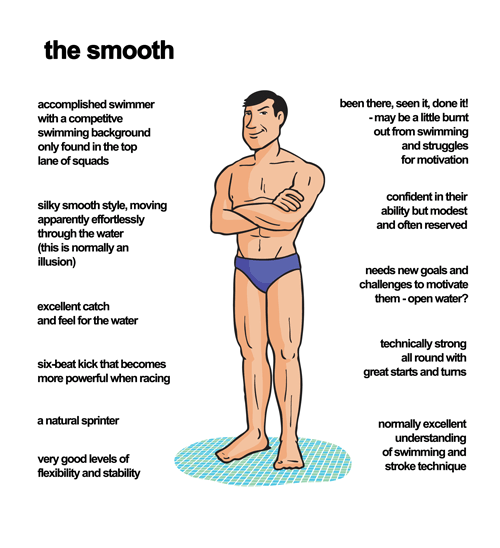
The Overglider has read all the books and taken the advice to 'swim long' too literally. Every stroke pauses out front, momentum dies, and the swimmer works harder to go slower.
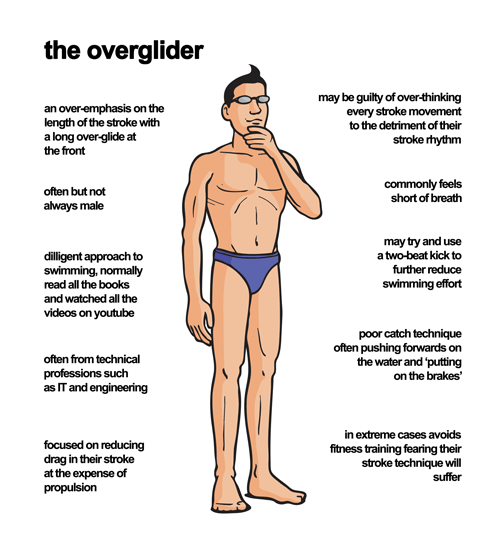
The Overglider is the most common Swim Type of all — and, ironically, the type created by trying to swim well. These are thoughtful, technical swimmers who've read the books, watched the videos and taken 'lengthen your stroke' and 'glide' entirely to heart.
The result is a dead spot at the front of the stroke: the lead hand pauses, momentum drains away, and the swimmer has to accelerate the whole body again from near-zero on the very next stroke. Overgliders work extraordinarily hard to swim slowly, and they usually can't find a higher gear when they need one.
Overgliders often have beautiful body position and streamlining. Everything is there except rhythm — which is why the fix, once accepted, produces quick and satisfying results.
→Obvious pause at full extension every stroke cycle
→Very low stroke rate, often below 50 strokes per minute
→Overrotation onto the side, sometimes past 60 degrees
→Hands crossing the centre line and pressing down out front
The pause kills momentum and forces the swimmer to restart the body from a standstill every single stroke.
Below about 50 spm most swimmers simply cannot maintain speed — especially in open water and chop.
Rolling too far slows the recovery and makes the swimmer unstable in rough water.
Straight-arm pressing at the front lifts the chest and stalls the catch.
Sequence matters more than effort. Work through these in order — skipping ahead is why most stroke work fails to stick.
Use a Tempo Trainer Pro and lift the rate by 3–4 spm at a time until you're comfortably in the 55–70 spm band.
Think 'catch as the hand lands'. The lead hand should never stop moving.
Roll enough to breathe and access the catch, no more. Stay compact and connected.
Stroke count is not a score. A slightly higher count at a higher rate is almost always faster.
6 × 100m increasing the tempo by 0.03s every 100m. Discover how much faster you go before it feels hard.
8 × 25m at a rate above your comfortable maximum to break the ingrained pause.
4 × 100m off short rest at target open-water rhythm.
Almost every self-coached swimmer who took 'swim longer, not faster' at face value has spent time here.
The fully revamped Swim Smooth Overglider PDF: stroke analysis, the complete fix order, drills, sets and a training structure written specifically for this type.
Get it for $9.99The Guru holds the complete stroke-correction pathway for The Overglider, plus Stroke Insights — which identifies your type from your actual swimming data, not just the questionnaire.
Explore the GuruAdd rhythm and the Overglider becomes a Smooth or a Swinger — usually within a matter of weeks.