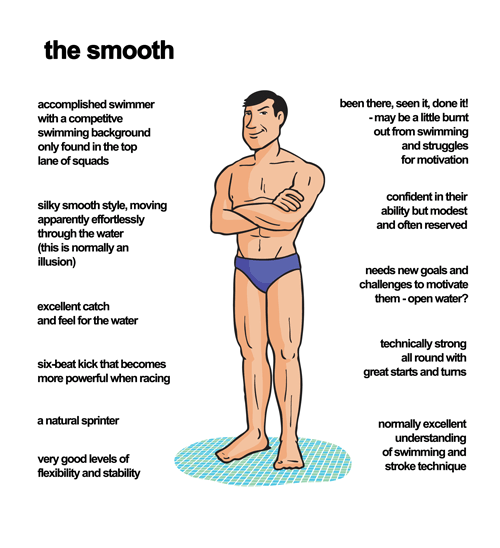
Low body position
Sinking legs create huge frontal drag. Everything else you fix will be undone until the hips come up to the surface.
Big engine, fighting the water
Strong, powerful and determined — the Arnie muscles through the water rather than moving with it. Often a former runner, cyclist or gym athlete who brings raw horsepower to a sport that rewards finesse first.
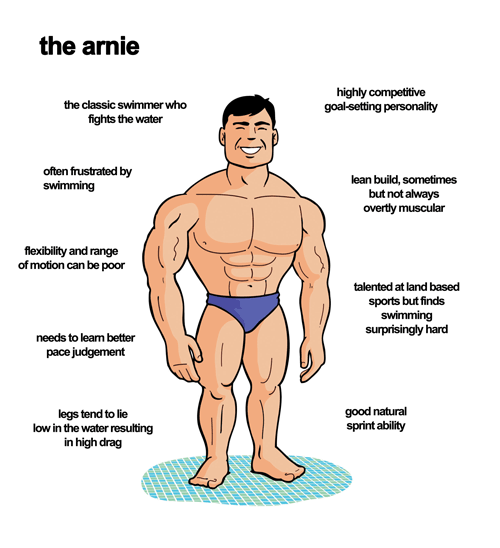
Arnies are the powerhouses of the swimming world. Typically strong, fit and highly motivated, they arrive at swimming from running, cycling, rowing, rugby or the gym — sports where more effort reliably means more speed. Water doesn't play by those rules, and that's the whole story of the Arnie.
Because the stroke is short and the legs sink, an Arnie has to fight for every metre. The frustrating part is that the fitness is already there: put an Arnie on a bike or in running shoes and they're often the strongest athlete in the squad. In the pool, that same engine is being poured into overcoming drag rather than creating propulsion.
The good news is that Arnies improve dramatically once the emphasis moves from 'work harder' to 'move better'. Lengthening the stroke and lifting the legs typically takes 10–20 seconds per 100m off an Arnie's pace without a single extra session of fitness work.
→Legs trailing low, often with a wide scissor kick to prop them up
→Arms recovering low and wide, hands entering short of full extension
→Head lifted, eyes forward, chest riding high and hips dropping
→Heavy, rushed breathing pattern with the head turning too far
Sinking legs create huge frontal drag. Everything else you fix will be undone until the hips come up to the surface.
The hand enters and immediately pulls, so there's no length to work with and very little distance per stroke.
The legs split open on the breath to stop the body rolling — an instinctive brake applied twice a cycle.
Looking forwards is comfortable and costly: every centimetre the head lifts, the hips drop further.
Sequence matters more than effort. Work through these in order — skipping ahead is why most stroke work fails to stick.
Press the chest lightly, lower the head so you look down and slightly forwards, and exhale continuously into the water. Body position first, always.
A light, compact, continuous six-beat kick from the hips keeps the legs together and the body rolling as one unit.
Extend the hand forwards to full length before starting the catch. Aim to reduce your stroke count by 2–4 strokes per length without slowing down.
Once the stroke is long and the legs are up, your engine finally has something to push against. This is where Arnies get very quick indeed.
6 × 50m kick on your side with fins, one arm extended, eyes down. Rebuilds the sense of a long, high body line.
8 × 50m holding the same pace while dropping one stroke every second 50. Teaches length without losing speed.
400m easy breathing every 3, exhaling fully underwater. Removes the panic that shortens the stroke.
Think of the powerful, land-strong athlete converting to swimming — the fix is never more effort, it's better shape in the water.
The fully revamped Swim Smooth Arnie PDF: stroke analysis, the complete fix order, drills, sets and a training structure written specifically for this type.
Get it for $9.99The Guru holds the complete stroke-correction pathway for The Arnie, plus Stroke Insights — which identifies your type from your actual swimming data, not just the questionnaire.
Explore the GuruFix body position and length and the Arnie becomes a Swinger or a Smooth — often the biggest transformation of all six types.